






 Trap
 Continuous
Monster Rebone
View:
3342
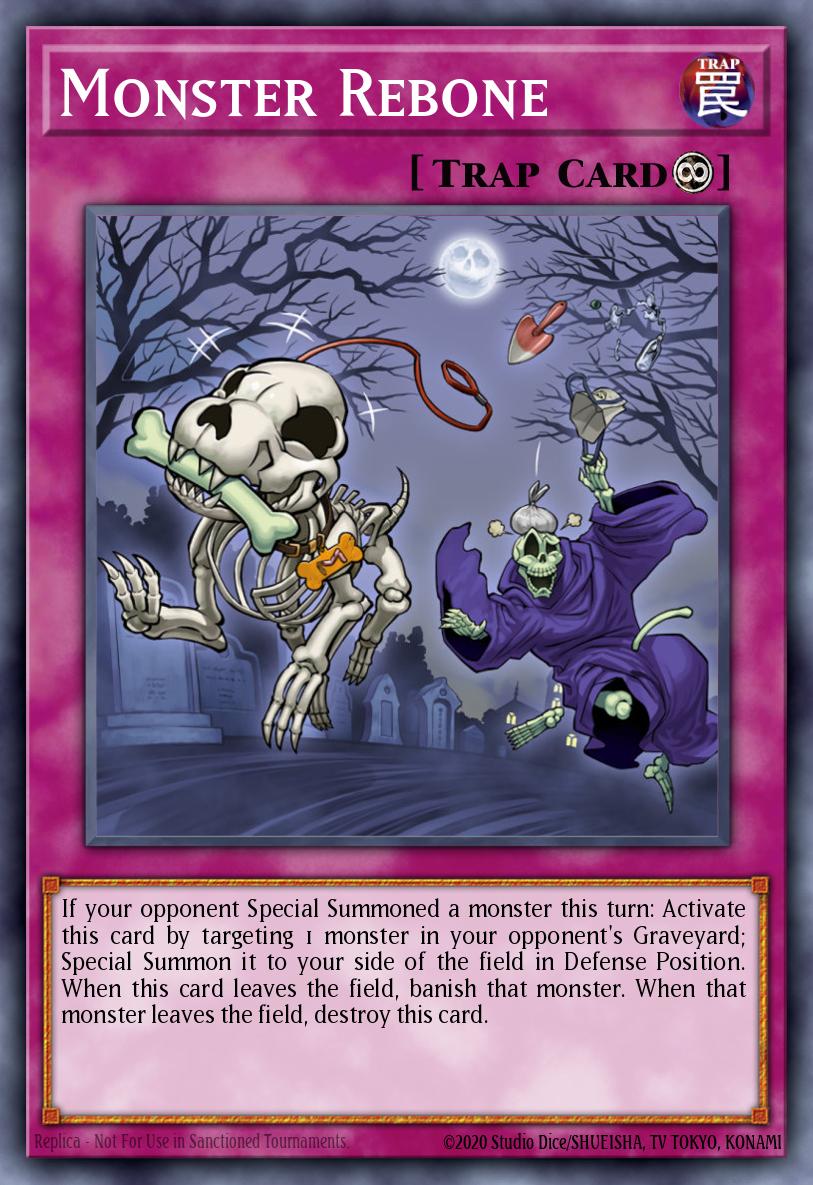
If your opponent Special Summoned a monster this turn: Activate this card by targeting 1 monster in your opponent's Graveyard; Special Summon it to your side of the field in Defense Position. When this card leaves the field, banish that monster. When that monster leaves the field, destroy this card.
Monster Rebone — Power Evaluation
Final Score: 53 ± 6 · Confidence: Medium
- Intrinsic: 56 · Deck: 56 · Meta: provisional
- Primary role: Removal / Negation · Secondary: Board breaker, Recovery/Recursion
Why it scores here
Monster Rebone is a reactive trap that steals opponent's Graveyard monsters when they Special Summon, providing conditional resource denial and board control through a form of soft removal. The effect has clean deckbuilding efficiency, fitting naturally into trap-heavy strategies across multiple archetypes with no archetype lock. However, its power is severely limited by the reactive activation condition (only works if opponent Special Summoned this turn), the DEF-position placement that restricts offensive value of stolen monsters, and the mutual destruction link between trap and target that creates a fragile, non-resilient board state. The card generates no combo value and excels only situationally.
Axis scores
| Axis | Score | Evidence |
|---|---|---|
| Accessibility | 55 | Activation condition (opponent Special Summoned this turn) is frequently met in modern Yu-Gi-Oh!, and the card is documented in 13 decks at 1-2 copies, but as a Continuous Trap it requires setup and lacks active search routes (verified). |
| Combo & Conversion | 30 | Zero combo appearances in the evidence; the card does not build, extend, or create disruptive end-boards—it is purely reactive to opponent's summoning (verified). |
| Resource Economy | 50 | The card trades 1 trap slot for 1 temporary stolen body in DEF position, providing no card advantage refuel or repeated value beyond the single summon response (inferred). |
| Effect & Interaction | 60 | Steals opponent's GY monsters (soft removal/negation) when they Special Summon; meaningful disruption when condition is met, paired with strong trap partners like Infinite Impermanence (69.2% co-deck rate, verified). |
| Material Utility | 48 | The trap itself is a 0/0 card with no inherent material value; the stolen monster can be used as Synchro/Xyz/Link material in DEF position, providing moderate utility before mutual destruction (inferred). |
| Resilience & Flexibility | 35 | The trap and stolen monster are linked (each destroys the other), offering no recovery path, multi-zone play, or resistance to interaction; a single removal ends both pieces (verified via card text). |
| Deck-Building Efficiency | 68 | Runs clean at 1-2 copies with no archetype restriction, self-lock, or brick risk; splashable into trap-heavy control across 10 documented archetypes including Black Luster Soldier and Gaia (verified). |
Calculation
Weight profile: 0.7·Removal/Negation + 0.3·Board breaker. Intrinsic ≈ 56, Deck ≈ 56, Meta = provisional. Modifiers: Reactive activation condition (-2); Mutual destruction mechanic (-1). Final formula: 0.40·Intrinsic + 0.60·Deck
Strengths
- Reactive resource denial that steals opponent's GY monsters for board control
- Clean deckbuilding with no archetype lock, runs at 1-2 copies without friction
- Strong trap synergy: pairs with Monster Reborn (69.2%), Infinite Impermanence (69.2%), Mirror Force (61.5%)
- Straightforward card text with clear activation and timing (no complex rulings)
Weaknesses
- Reactive activation condition (requires opponent Special Summon) limits proactive value
- Stolen monsters placed in DEF position provide only defensive utility
- Mutual destruction link with stolen monster creates fragile, non-resilient board
- Zero combo evidence; generates no turn extension or end-board construction
- Small deck sample (13 total) limits statistical confidence in playability
Counters / choke points
- Preventing opponent's Special Summon (negates activation condition entirely)
- Spell Speed 2+ negation before effect resolves
- Removing the stolen monster (triggers mutual destruction with trap)
- Destroying the trap before stolen monster generates value
Best use
Reactive removal/resource denial in trap-focused secondary strategies. Decks: Black Luster Soldier, Gaia The Fierce Knight, Trap-heavy control. Suggested copies: 1.
Evidence & gaps
- Verified: Continuous Trap requiring opponent's Special Summon this turn as activation condition; Targets 1 monster in opponent's Graveyard; Special Summons to player's field in DEF position; Mutual destruction link: card leaving field banishes the monster; monster leaving field destroys the card; Documented in 13 decks across 10 distinct archetypes (Black Luster Soldier, Gaia, Hole, Egyptian God, Sky Striker, Plunder Patroll, and 4 others); Runs at 1 copy in 11 decks, 2 copies in 2 decks (average 1.15 copies per deck); Top partners: Monster Reborn and Infinite Impermanence both at 69.2% co-deck rate
- Observed: 76.9% of documented decks use gameplay type-4; minority representation in types 10, 6, 3; Consistent inclusion across trap-heavy control strategies; Paired with diverse disruption suite: Mirror Force (61.5%), Ash Blossom (53.8%), Torrential Tribute (53.8%)
- Inferred: Activation condition frequently satisfied in modern Yu-Gi-Oh! where Special Summoning is prevalent; Steals opponent's GY resources, providing resource denial and soft removal; Reactive nature limits proactive combo potential and turn extension; DEF placement restricts offensive value; stolen monster serves primarily as material or defensive blocker; Mutual destruction mechanic limits resilience; removing either piece ends both
- Data gaps: No combos supplied—combo conversion and combo synergy assessed via text-only inference No guides supplied—no external strategy validation or role confirmation No banlist token—assumed 3 copies unlimited in all formats No usage statistics (StatisticsCard rows)—archetype inclusion percentages derived from 13-deck sample only Small deck sample (13 total) limits statistical power; 95% CI for true inclusion would be wide No tournament representation, top-card rankings, or meta-context